Basic Principles of the Reggio Approach
- The Image of the Child
- The Role of Relationships and Reciprocal Interactions
- The Role of Parents, Family and Community
- The Role of Space
- Teachers and Children as Partners in Learning
- Curriculum as a Process of Inviting and Sustaining Learning
- The Power of Documentation
- The Hundred Languages of Children
- Projects, Emerging from Children's ideas and/or Teacher's Intentions
Very brief summaries of some of the underlying principles or values of the Reggio Approach to Early Education appear below. These summaries are only meant to give you a tiny taste of Reggio-inspired practice. To learn more, take a look at our Recommended Reading page.
The belief that children are born strong and capable, with rights, knowledge and the motivation to pursue learning.
The Role of Relationships and Reciprocal Interactions
The belief that children cannot be extracted from the context - the family, the community, the culture and the world - in which they live. This system of relationships permeates the school.
The Role of Parents, Family and Community
Parents, family and community are essential and integral parts of the child's school experience.
The space of the school is designed to support all of the values held under the Reggio Approach, in particular encounters and relationships with people, objects and ideas.
Teachers and Children as Partners in Learning
The teachers are not simply practitioners implementing a curriculum designed by experts. Instead, they, like the children are valuable researchers who are not reproducing culture or knowledge, but rather creating it together.
Curriculum as a Process of Inviting and Sustaining Learning
Curriculum and learning is co-created in a spiral process of inviting encounters; listening to the traces of learning left by the children; discussing and interpreting these traces cooperatively; and responding in a way that invites further enounters.
Documentation takes many forms and is designed to capture traces of learning and living left by the children, so that they may be discussed and interpreted for the creation of curriculum, used in the ongoing research of the teachers, and provide further understanding for the children.
The Hundred Languages of Children
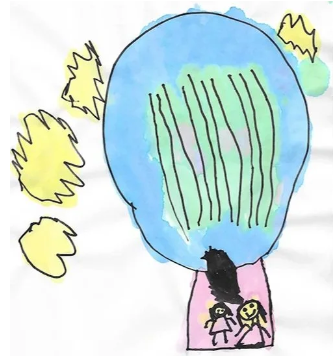
Children communicate what they know, think, question and feel in many ways other than just verbally. This communication gives teachers and the children themselves insight into the learning process, their research projects, and the creation of curriculum. A trained visual arts teacher supports the children in their use of graphic arts for communication.
Projects, Emerging from Children's Ideas and/or Teacher's Intentions
Learning activities, created as a cumulative result of all the values above, take the form of group projects which vary in form and duration.